
Winter trips have a reputation for being carry-on killers. The coats are thick, the boots are heavy, and somewhere in the back of your head a voice says "what if it's colder than the forecast?" and suddenly you're sitting on a suitcase trying to zip it.
You don't need the big suitcase. You need a system. Here's one that works, whether you're headed for a long weekend in Austria or two weeks chasing snow in Finland.
Think in layers, not in outfits
The biggest mistake in winter packing is treating each day as a separate outfit. Cold-weather clothing doesn't work that way. It works in three layers:
- Base layer — thin merino or synthetic tops and bottoms that sit against your skin. Merino can be worn several days without smelling like it. Two sets cover a week.
- Mid layer — one fleece or light down jacket. This is your warmth. It also doubles as your "nice enough for dinner" layer if you pick a plain colour.
- Shell — one jacket that blocks wind and rain. Warmth comes from underneath, so it doesn't need to be bulky.
Three base tops, two base bottoms, one mid layer, one shell. That's the core of the bag, and it handles everything from a brisk city walk to standing on a frozen lake wondering why you're standing on a frozen lake.
Wear the heavy stuff on the plane
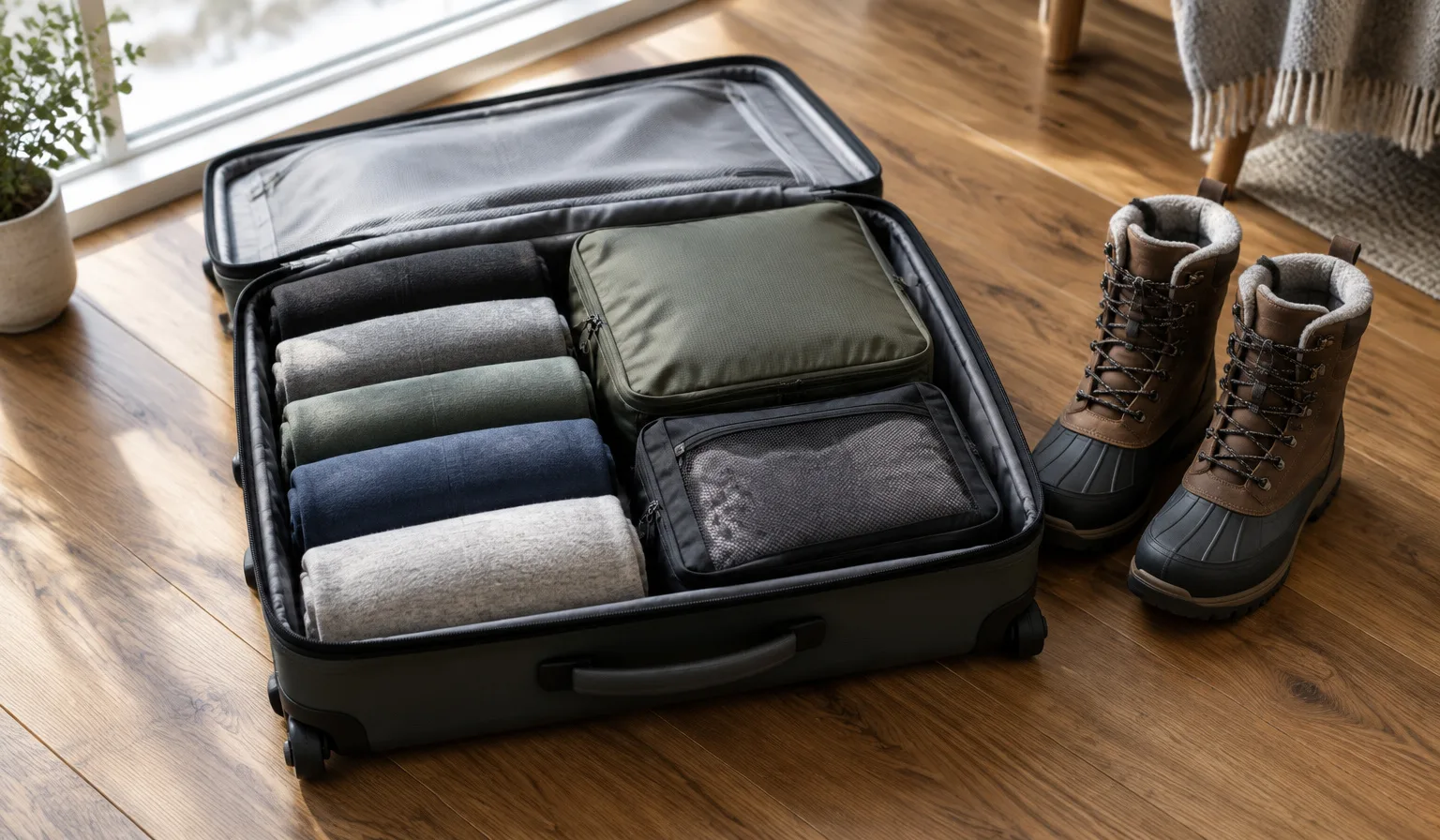
Your boots and your biggest jacket never go in the bag. You wear them. Yes, airport security becomes a small wrestling match. That's the tax. A pair of good waterproof boots on your feet frees up roughly a third of a carry-on.
One pair of boots is enough. If they're comfortable for a full day of walking and keep slush out, they're the only footwear you need. The second pair of shoes "just in case" is how one-bag trips die.
Packing cubes and compression do the rest
Winter clothing is mostly air. Compression packing cubes squeeze that air out and turn a puffy mid layer into something the size of a loaf of bread. Use one cube for base layers, one for everything else, and keep socks and gloves stuffed inside your boots if the boots do have to travel in the bag at any point.
Roll the base layers, fold the mid layer flat on top, and leave the shell accessible — you'll want it the moment you step outside the terminal.
What to leave behind
This is where the bag is won or lost:
- The third sweater. You will wear the same two. Everyone does.
- Jeans. Heavy, slow to dry, and cold when wet. One pair of travel trousers over a base layer beats them in every way.
- The full-size toiletries. Hotels and pharmacies exist in cold countries too.
- A spare "big" jacket. If your layer system works, there's no scenario where you need two shells.
- The physical SIM card errand. Connectivity doesn't need space in your bag at all. An eSIM installs on your phone — do it on the day you travel, since plan validity starts at install — and arriving means turning off airplane mode, not finding a kiosk in the snow. If your winter route crosses borders, a single plan can cover more than one country, so you set up once.
A quick word on gloves and hats
One warm hat, one pair of gloves, one buff or scarf. These weigh almost nothing, so this isn't about saving space — it's about not losing them. Keep them in the same jacket pocket every time. Future you, patting pockets outside a train station at dusk, will be grateful.
The takeaway
A winter carry-on comes down to one idea: warmth is a system you wear, not a pile you pack. Three thin layers beat one thick one, the boots go on your feet, compression handles the bulk, and everything that "might be useful" stays home.
Pack it once this way and you'll wonder why winter ever needed the big suitcase. Then the only heavy thing left to carry is the decision of where to go.